Are drain Chains Safe for Pipes With Channel Rot?
While we suggest using a Picote Smart Spider in drains with channel rot, we do understand that our customers might not have one on hand.


The lifespan and performance of a flexible shaft depend significantly on selecting the right design and construction.
Our flexible shafts are crafted using multiple layers of premium spring-grade wire, tightly wound around a central mandrel. Each layer is wound at an opposing pitch angle, ensuring balanced torque delivery in both rotational directions. The shaft’s overall quality is determined by factors such as wire type, number of layers, diameter, and annealing temperature.
Critical properties like flexibility, torsional stiffness, power transmission, and performance across different speeds are influenced by the careful combination of these design elements.
By adhering to these core design principles, you can achieve consistent, reliable, and long-lasting performance.
The length of the shaft is measured at its minimum size. We supply shafts that are slightly longer than the minimum, allowing clients to attach various tools.
To protect the shaft ends from wear, friction rings are included in the sleeve design. These rings also prevent debris accumulation between the shaft and sleeve, allowing for efficient torque transfer from the drill to the tool, which enhances overall system performance.
Experienced users often prefer a shorter shaft for daily use and keep an additional shaft and connector in their vehicle. This approach simplifies transportation, as carrying a long shaft to the workspace is unnecessary. When extra length is required, the secondary shaft can be quickly retrieved and connected to the one in use.
Having two separate shafts also ensures a backup in case of accidental damage, eliminating the need for immediate repairs before resuming work.
The correct method for choosing the right shaft length is to check the layout of your drains and measure the distance between each cleanout point. Ideally, you want a shaft length that either matches the distance between cleanouts or is about half that length. This allows you to reach and clean both upstream and downstream sections effectively, covering the most common blockage areas without using excess shaft length.
The appropriate shaft thickness depends on the number of bends it needs to navigate. A thinner shaft is better suited for multiple bends, but it delivers less torque compared to thicker options.
The 6mm Flexible Shaft: This flexible shaft is ideal for 32mm-50mm pipes and can navigate multiple bends with ease. However, its limited torque makes it better suited for blockage removal than descaling. While it can descale a pipe, the process will take more time to achieve the desired results.
8mm Flexible Shaft: The second most flexible option, capable of navigating multiple bends while delivering more torque than the 6mm model. Ideal for pipes 75mm to 100mm in diameter, it works effectively with blockage removal and descaling chains.
10mm Flexible Shaft: Less flexible than the 8mm but more so than the 12mm shaft. It handles fewer bends than the 8mm but provides torque similar to the 12mm. Suitable for pipes 75mm to 150mm in diameter.
12mm Flexible Shaft: The most rigid option, offering the highest torque. Popular for failed liner removal, descaling, and blockage removal in pipes ranging from 100mm to 250mm.
During manufacturing, the shafts are wound in a long, straight line before being placed on a large diameter spool and then cut into smaller sections. As a result, when you first use your shaft, you might notice slight shrinkage at the ends, especially at the drill end.
This is a normal occurrence as the shaft undergoes stress from multiple bends and torque for the first time. Once the initial inner strands of the flexible shaft settle into their permanent positions, the shrinkage will stop. Typically, this affects about 3” (75mm) on each end of the shaft. If you observe this, simply cut off the shrunken section with an angle grinder and reconnect your chains and drill. Welding the ends is not necessary, but if you choose to do so, be cautious to avoid excessive heat on the shaft.
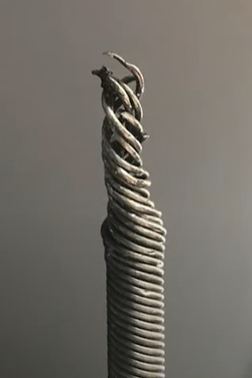
For a detailed explanation of shaft shrinkage, check out our video tutorial.
 Български
 Hrvatski
 Čeština
 Dansk
Dansk Nederlands
 English
 Eesti
Eesti Français
 Deutsch
 Ελληνικά
 Magyar
 Italiano
 Lietuvių kalba
 Polski
 Português
 Română
 Slovenčina
 Slovenščina
 Español
 Svenska